


Use the steps below to practise your interview using ChatGPT Voice. You will upload your CV and the job description, ask ChatGPT to act as your interviewer, and then answer questions aloud as you would in a real interview.
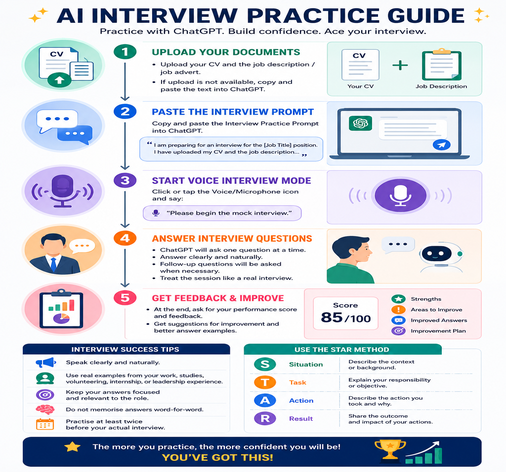
1. Candidate Instructions
Follow these steps:
| Step | What to Do |
| 1 | Open ChatGPT and log in to your account. |
| 2 | Upload your CV and the job description/job advert. If upload is not available, copy and paste the text into ChatGPT. |
| 3 | Copy and paste the Interview Practice Prompt below into ChatGPT. |
| 5 | Click or tap the Voice/Microphone icon in ChatGPT. |
| 6 | Say: “Please begin the mock interview.” |
| 7 | Answer each question aloud as you would in a real interview. |
| 8 | At the end, ask ChatGPT to rate your performance and give feedback. |
2. Interview Practice Prompt
Copy and paste the prompt below into ChatGPT:
“I am preparing for an interview for the [insert job title] position.
I have uploaded my CV and the job description. Please analyse both documents and conduct a realistic mock interview for this role.
Ask me one question at a time. Wait for my answer before asking the next question. Ask follow-up questions where necessary.
Use a professional interviewer style. At the end, please rate my performance out of 100 and provide feedback on relevance, structure, clarity, confidence, use of examples, and role fit. Also provide improved versions of my weakest answers.
Please read my CV and the job description. Confirm when you are ready to begin the voice interview.”
3. Start the Interview Practice
After ChatGPT confirms that it has read your CV and the job description:
- Click or tap the Voice/Microphone icon.
- Say: “Please begin the mock interview.”
- Answer the questions clearly and naturally.
- Treat the session like a real interview.
At the end of the session, say:
“Please score my interview performance out of 100 and give me practical feedback. Also, give me a short improvement plan before my actual interview.”
4. Important Tips
- Speak clearly and naturally.
- Use real examples from your work, studies, volunteering, internship, or leadership experience.
- Do not memorise answers word-for-word.
- For behavioural questions, use the STAR method: Situation, Task, Action, and Result.
- Keep your answers focused and relevant to the role.
- Practise at least twice before your actual interview.
