


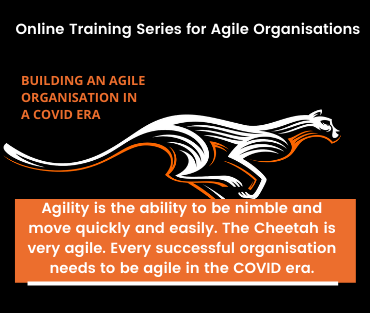
Building An Agile Organisation In The Covid Era
COVID19 has challenged every organization, be it a business, not for profit or government. The supply chains and access to customers are disrupted, negatively impacting the revenues and profitability. Project implementations of NGOs are interrupted, and the government services are affected. With the imposition of lockdowns and social distancing norms, employees cannot come to the workplace and are forced to work from home.
The situation demands that organizations need to be agile. They should re-strategize and realign the business processes to survive and sustain. Agility is the ability to be nimble and move quickly and easily. Every successful organization needs to be agile in the COVID era.
Organizations need to review their systems and procedures and, train and motivate staff to be agile. The employees at all levels must be trained. The training programs should be designed to meet the needs of specific employee categories. For example, the employees at the operational level, the line managers, the remote facilitators, and the HR managers need a combination of different skills to be agile.
Training for Employees: Employees constitute the army of the organization. Imagine if they did not have clarity about what to do while working from home. One word: chaos! That is precisely why the training for employees should be structured to enable them to work collaboratively, even as they work remotely.
The training should address the crucial aspects that will improve work efficiency. To start with the employee should know how to set up a conducive workstation at home. The training should convey to the employees what it takes to be digitally agile, how to stay motivated while working from home amidst distractions and how to manage time efficiently.
Training for Managers: Working from home requires managers to stay in constant touch with their teams. Besides, it is also essential for them to ensure that the team members can communicate effectively with each other. Well, at the office it may be easy, but while working remotely, it is a different ball game altogether!
The training program for managers should share the best practices, and practical techniques to orchestrate multiple activities efficiently. These practices empower them to stay on track with the organizational goals and achieve them as per schedule. The program should impart the art of superior management, where one gets to learn how to facilitate, delegate, and collaborate when working remotely.
The training for managers should be aimed at developing their capacity to achieve superior performance in a remote work setting through better planning, organizing, and improving the overall productivity of the team.
Training for Remote Facilitators: The trainers and executives who are required to make presentations as part of their work need specialized facilitation skills. They must be equipped with techniques for imparting the skills and knowledge to others.
The aim of this training should be to equip trainers with all the necessary skills needed to conduct effective online training programs, successful workshops, and high-powered meetings.
Training for HR Manager: The role of HR is especially in challenging times like COVID19. Knowing how to streamline effective workflow among employees who are working from home, ensuring that their morale is high and unwavering in addition to the regular HR activities is not easy.
The training should enable HR Manager to plan and build systems and procedures for remote working and create an agile organization that will improve the overall employee and organizational performance.
